
Robotic Knee Replacement
Robotic Knee Replacement
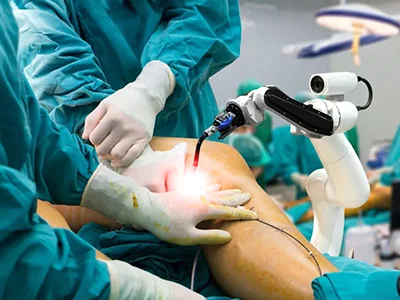
Robotic Knee Replacement is an advanced surgical technique where robotic-assisted technology is used to replace the damaged knee joint with higher precision and accuracy. This modern approach allows the surgeon to create a customized plan based on the patient’s unique anatomy, ensuring better alignment of the implant, minimal tissue damage, reduced pain, and faster recovery compared to traditional knee replacement methods.
What You Can Expect
Before the procedure
Prior to surgery, your doctor will conduct detailed evaluations such as X-rays or CT scans to design a personalized surgical plan. You will also be guided about your medical history, existing health conditions, and current medications. In addition, your surgeon may suggest certain lifestyle modifications, exercises, or dietary changes to prepare you for the procedure and improve overall recovery outcomes.
During the procedure
The surgery is performed under anesthesia, and a robotic system assists the surgeon throughout the operation. The robotic arm helps in creating precise bone cuts and placing the implant with maximum accuracy, based on real-time mapping of your knee. While the robot enhances precision and safety, the surgeon remains in complete control of the entire process, ensuring a highly effective and tailored knee replacement.
After the procedure
Once the surgery is complete, you will be closely monitored in the recovery area before being shifted to your hospital room. Pain management and wound care are started immediately, followed by early physiotherapy sessions to restore mobility and strengthen the knee. Most patients are able to stand and walk sooner, experience less discomfort, and achieve quicker recovery with long-lasting improvements in knee function.
What You Can Expect
Before the procedure
Knee replacement surgery requires anesthesia. Your input and preference help the team decide whether to use general anesthesia, which makes you unconscious, or spinal anesthesia, which leaves you awake but unable to feel pain from your waist down.
You’ll be given an intravenous antibiotic before, and after the procedure to help prevent post-surgical infection. You might also be given a nerve block around your knee to numb it. The numbness wears off gradually after the procedure.
During the procedure
Your knee will be in a bent position to expose all surfaces of the joint. After making an incision about 9-12cm long, with Subvastus technique doctor enter your knee joint without cutting the muscle, and only by reflecting the muscle entire knee replacement surgery is done.
After preparing the joint surfaces, the surgeon attaches the pieces of the artificial joint. Before closing the incision, he or she bends and rotates your knee, testing it to ensure proper function. The surgery lasts about two hours.
After the procedure
You’ll be taken to a recovery room for one to two hours. How long you stay after surgery depends on your individual needs. Medications prescribed by your doctor should help control pain.
You’ll be encouraged to move your foot and ankle, which increases blood flow to your leg muscles and helps prevent swelling and blood clots. You’ll likely receive blood thinners & anti-inflammatory to further protect against swelling, pain and clotting.
You’ll be asked to do frequent breathing exercises and gradually increase your activity level. A physical therapist will show you how to exercise your new knee. After you leave the hospital, you’ll continue physical therapy at home or at a center.